

It’s the theme I return to above all others, because, (a) it is the theme that has been central to my own negotiation of and recovery from the conflicts that have been the most disturbing and overwhelming and, (b) when working as a mediator I’ve come to realise it is the one aspect of conflict, that those who are in conflict, have control over. The theme is: when in conflict, turning towards ourselves and our own experience.
When we are in conflict with another person or people, we will have thoughts and feelings related to this conflict. I’m going to term these thoughts and feelings as “symptoms”. These symptoms are likely to disturb our sense of peace or equanimity and can manifest as loops of distressing thoughts and feelings, a persistent unchanging hurt or anger, simmering resentment, feelings of powerlessness, pain, rage. The conflict manifests in our emotional world, our energetic field, the phenomenological and experiential architecture when we touch the heat of the conflict situation.
So often, when navigating the pain and wider disturbance of conflict situations, we focus on what we find out there in the world around us. We identify a person, group, or situation and firmly channel our emotions in their direction. Maybe this identification of an external aggressor, provides us with some immediate relief. Perhaps locating a culprit can anchor our hurt and rage.
Indeed, if feelings of anger, inertia, sadness (all possible manifestations of conflict) arise without a clear culprit being identified, we can be left feeling utterly disorientated, confused, depressed even. We have all these difficult thoughts and feelings but no identified source. It can be helpful, maybe even essential, to have a focus for all the symptoms of conflict we are experiencing.
At the same time, what I often notice when mediating and from my own conflicts historically, is that we may identify a source for the conflict that resides in the world around us but then get stuck at this stage. We lock the doors, batten down the hatches, unremittingly attach ourselves to a version of a narrative that supports the way we see the world. We peer out from our bunker with our hurts and pain and call out, “there’s the monster! It’s over there!”
And maybe all this is true. Maybe there is a monster out there. The difficulty we’re presented with though, is that the monster is somewhere on the scale from “usually to always”, outside of our control. It’s not to say we can’t try and influence it (see graphic below), but how far can we be assured that we can capture, tame and control the monster for all the years we have ahead? Also, this task of trying to control our environment, should we choose to take it on, usually comes at a huge personal emotional, energetic and physical cost.
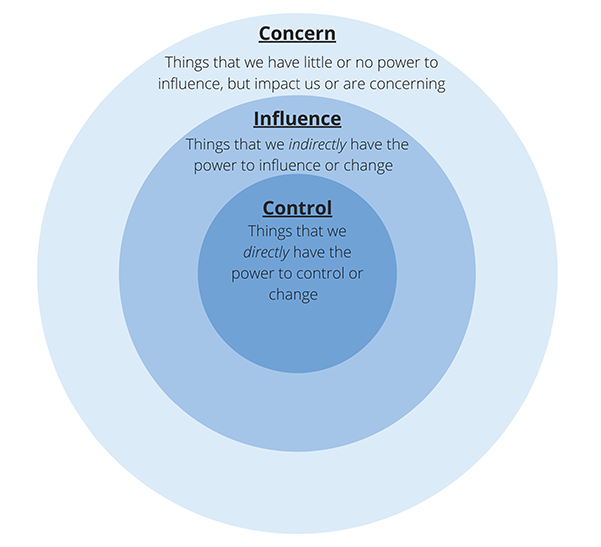
[this particular image is from UCMERCED Human Resources Dept, but is a model widely used in HR and therapeutic contexts. It’s often commonly known as the “Circles of Influence” model. It is a model to explore – related to conflict transformation – more fully in a future article.]
Because as we press the alarm button and urgently yell “It’s over there!”, we are usually identifying with a helpless part of ourselves and we stay stuck in a trench of stress, tension, and other painful emotions such as anxiety and fear.
We are waiting for someone else out there to come and rescue us, but more often than not the rescue doesn’t happen. I would strongly contend that this is in large part because ultimately, we are the only ones who can rescue ourselves.
So, I come back to the start of this article. What we can do, what we have control over, is to turn to the experiences within us. This, we have at least a degree of power and control over. As we turn to look at these experiences, we give ourselves an opportunity. We have agency.
As we begin to address the thoughts, feelings, and inner conflicts we are experiencing, we are then also better placed to deal with the conflict we have with a person or persons out there in the world around us. Over time it is likely we will find ourselves better equipped and resourced to engage with aspects of our environment that we may previously have found challenging. We give ourselves the possibility of moving from this stuck place.
I believe it is important to highlight that to address our own inner experiences is not to withdraw to a place of isolation and try to work it out ourselves. Quite the opposite, we are invariably going to need support along this journey. This may be in the form of wise friends, family, colleagues, professionals such as therapists, coaches, mentors. Or it could be in the form of healthy routines, or access to quality resources to help develop insight and thinking. Or it could be in many other different ways, whatever may strengthen the resilience and spirit, whatever may help open the heart and promote curiosity, whatever may support increased awareness and a sense of self-compassion.
The coming articles will focus more specifically on how to address our inner experiences and what categories of inner experiences we may find, whilst maintaining the key focus of how we move forward in a way where we feel better within ourselves and therefore better in our relationships with others. Bearing in mind that I would contend that these two aspects, feeling better within ourselves and better in our relationships with others, are inter-dependent.
Nick Adlington, go-dialogue.co.uk